Tuesday, November 21, 2017

The Perfect Place to Stay in Costa Rica

Costa Rica is one of the finest locations for a romantic honeymoon or even some quiet off time from the city. Everyone who visits Costa Rica has only thing to say about it — ‘it’s a paradise.’ Why don’t you come and stay in paradise?

Planning a Costa Rican vacation is not difficult. You can find information about the best Costa Rica holiday packages online. It  won’t take long . Here’s a small secret to the perfect Costa Rican vacation: decide the resort first.

Variety of choices

There are many luxury hotels and resorts in Costa Rica that provide great amenities to  visitors and promise an authentic ‘paradise’ experience. For starters, visit Montezuma. It’s a favorite among tourist spots in Costa Rica and provides splendid views of the ocean that will mesmerize you instantly. This is prime real estate for anyone who wants to have a great time in this enchanting place.

Don’t worry. There are many beautiful Hotels in Montezuma that provide you with great luxury accommodations. You will not only get a great stay, but have easy access to some of the best locations in the area. Consider staying in a fine resort like Ylang Ylang. Here you’re offered a relaxed, secluded environment that’s still close enough to Montezuma to allow you access to the city.

Get the best of both worlds

Staying here is the best of both worlds – a serene, private location surrounded by native scenery,  just  a short distance from the rich, lively culture of Montezuma. This is the perfect blend for a tourist who wants to enjoy the city but also demands some quiet time alone. We welcome you to Costa Rica at the Ylang Ylang resort, a place where you get everything that you demand within a split second. Not only that, holidays in Costa Rica are all-inclusive.


Filed under: Costa Rica Tagged: best Costa Rica holiday packages, culture of Montezuma, Hotels in Montezuma, romantic honeymoon
The Perfect Place to Stay in Costa Rica published first on https://ylangylangresort.com/

Monday, November 20, 2017

Psychological Separation Is Fragmentation

An amusing headline in a prominent California paper reads: ”What Separates Us From Chimps.” Though it may sound like a tautology, what separates us from chimps is separating ourselves from chimps, and everything else.

Scientists have pinpointed a few of the differences in the 1% of DNA we do not share with our closest primate cousins. They appear to be associated with “accelerated evolutionary changes” in genes associated with speech, hearing and brain development.

For example, there is evidence that hearing in humans was “specially tuned by natural selection to make possible the elaborate spoken language capability unique to humanity.”

Teasing out genetic differences will never give us a better understanding of ourselves however. Besides, even in terms of aggression and war, human and chimp natures may not be so different after all. (Bonobos have pacific and loving natures, but they have evolved strong pacifying behaviors that nip aggression in the bud.)
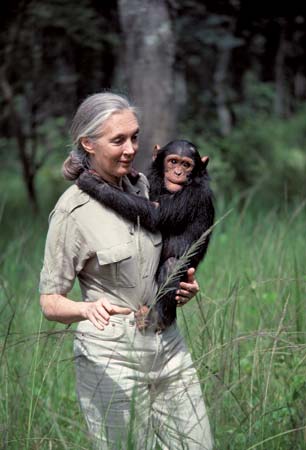
Primatologists have observed certain species of chimpanzees engaging in clearly planned hunting of other primates—for example, smaller and dumber rhesus monkeys. Jane Goodall has also observed, to her horror, the systematic extermination of one group of chimps by a rival group. Genocide in chimps, our closest cousins! Does nature go wrong with the evolution of so-called higher thought?

There is something inherently anthropocentric in seeking to find “the essence that makes us human.” Embedded within the phrase is the idea that the power and domination humans wield over other animals and each other somehow makes us special. However given that humans, a sentient and supposedly intelligent species are in the process of bringing about the Sixth Mass Extinction in history of life on earth, it actually means just the opposite.

The cheesy “Planet of the Apes” movies did have one interesting idea. The basic premise of the series (I lost track after three) was that if other apes were as smart as us, they would be just as speciesist and destructive as humans. If Goodall’s observations are any indication, then that idea has legs.

This raises another question: given the right conditions and enough time, do all earthlike planets inexorably produce consciously thinking species that foul and denude their planets until and unless they make the transition to true intelligence and consciousness?

As a person who has had so-called mystical experiences since his teens, allow me to introduce another dimension into this debate. When thought is completely quiet in unforced, unwilled attention, there is direct perception of beauty, wholeness and sacredness.

I’m not talking about any deity, but the unknowable essence (in the sense of words, concepts and knowledge) that permeates the universe. Time and space, matter and energy are seen and felt as an undivided, unfolding movement of wholeness, within which impersonal love and compassion intrinsic.

I feel no need to convince anyone of the existence of this actuality, even if there was a way I could say anything more about it. But it is a great curiosity to me that the human brain, which is dominated by symbolic thought, is fragmenting the earth and humanity all to hell, also has the capacity of being consciously aware of inviolability beyond all knowledge.

Perhaps that defines the “riddle of man.” I may have resolved it philosophically, but each of us has to resolve in our own hearts and minds.

Apparently a brain capable of conscious thought, whose basic principles are separation and manipulation, is a prerequisite for awakened consciousness. But that very evolutionary development initiates the ongoing existential mistake (“original sin,” in Christian lingo) of psychological division. The arrogance of human domination and technology precludes the full awakening of insight essential to end the fragmentation of the earth and ourselves.

The ages of man have ended. The pressure is growing in every responsible human being for transmutation, in direct proportion to man’s plundering of the planet.

Our age requires an evolutionary leap in our understanding and application of ‘higher thought’ in a sufficient number of people to make the transition to a genuinely intelligent species.

Martin LeFevre

Salary Versus Incentives in Costa Rica Employment

Costa Rica News – Employees from 82 public institutions regularly earn more in incentives than in basic salaries.

The companies with these policies include the Costa Rican Tourism Institute, the Social Protection Board, and Recope.

This is a common situation in the Public Administration. Out of the 329 state institutions, 82, or 25%, pay more in incentives than in salaries. It is no longer the exception.

This happens even among those with large budgets, such as the Costa Rican Social Security Fund. Others among this 25% include the Judiciary, the Costa Rican Electricity Institute, the Presidency of the Republic, the Legislative Assembly and the Ministry of Finance.

The Comptroller General views this disparity as distorting the nature of an incentive and the base salary. The result of dealing with low base salaries in this way ends up not being adjusted to the real possibilities of the Treasury Public.

From A Costa Rican Living in Cyprus

Costa Rica News – Crisanto Alonso Arias is a Costa Rican living abroad.

He shares his experience living in Cyprus, a calm European country. There, doors are left open and cars are left with the keys in the ignition with no fear of anyone stealing.

Still, there are various militaries present on the island, Turkish, Greek, and British. Syria, Turkey, Israel and Lebanon are uneasy countries that are neighbors. Military tensions may be unleashed in any moment, but this is far from the minds of those living there going about their day to day lives.

The capital of Cyprus is the last one in the world to be divided by a wall. Cypriots of Turkish origin and Greek Cypriots live peacefully, crossing between the two zones without any trouble.

The country boasts 340 sunny days a year, a cheaper cost of living than in Costa Rica, and great food. Still, Arias misses the rice and tamales of his home in Heredia, Costa Rica.

Costa Rica To Offer Free Wi-Fi Access In Public Spaces

Costa Rica News – Costa Rica’s telecommunications regulator, the Superintendencia de Telecomunicaciones (SUTEL) has announced the details of the national broadband network with free access to the Internet service, via “WiFi”, in public spaces.

The Programa Espacios Públicos Conectados (Connected Public Spaces) initiative will be financed with US$65 million dollars (¢114 billion colones) from the Fondo Nacional de Telecomunicaciones (FONATEL) – National Telecommunications Fund – to connect 985 wireless access points in 360 districts of the 82 cantons of the country, including parks, public libraries, train stations, public universities and civic centers for peace.

“The initial speed will be 100 megabytes, and its capacity will increase 50 megabytes every year until reaching 300 megabytes in the fifth year,” said Humberto Pineda, Director of FONATEL.

“This is the most ambitious Telecommunications project developed by the SUTEL, as administrator of FONATEL. We are sure that it will be an opportunity for economic and social growth for more than 4 million people benefited by the project,” explained Engineer Gilbert Camacho Mora, president of the SUTEL.

Users will be able to connect at speeds of 5 Mbps in the first year, 8 Mbps in the second, 10 Mbps in the third, 12 Mbps in the fourth, rising to 15 Mbps after 5 years.

Bids for tenders are open until 26 December, with the 10-year contracts due to be signed within the following 45 days, said SUTEL in a statement.

“The winning bidders will have a maximum of 24 months to put into operation each of the 515 zones chosen under criteria of population density, educational and cultural interest, “said the SUTEL.

From QCostaRica

Costa Rica Sharks Are In Ending Up in Shark Fin Soup

Costa Rica News – “President Donald Trump reportedly dined on shark fin soup during a meal in Vietnam.

The dish, which is considered an expensive delicacy in some countries, has prompted a widespread outcry from environmental groups for its links to animal cruelty.” (Yahoo.com)

More than likely this type of hunting of the shark fin had stamped on it “made in Costa Rica”, since we are one of the world’s largest suppliers of fins.

We have a plethora of sharks in our offshore waters, and a plethora of fishermen who harvest their fins although there are laws against such hunting.

The fishermen are pawns supporting a much larger “fin mafia” that is either overlooked by our government for environmental quality or brought to shore in a legal loophole.

The perpetrator’s dilemma is getting the fins to Asia. How to bypass Pura Vida law since the fin business is alive, and still profitable, extremely profitable.

The concept is to capture the sharks (Not so difficult with a piece of red meat), reel the poor bastards in and then cut off the prized dorsal fin while still alive. A dead dorsal is not as tasty.

Not long ago the fishermen just dumped the “fin less” live sharks back into the ocean and it was either soon dead or devoured.

But now, the only quest is to get rid of the bodies before boarding a ship in Moin headed for an Asian port of call. Then the dead corpses are dumped

All within the letter of the law, another Tico law whose letter of spirit and content gives way to doing the “It is not enforced or is simply overlooked.

From QCostaRica

Sunday, November 19, 2017

Northern Zone of Costa Rica; An Investment Hot Spot

Costa Rica News – The Northern Zone of Costa Rica has become a magnet attracting investment projects.

One example, a Tico-Panamanian company will channel $40 million in the cardboard box industry and will produce 200 jobs.

The Global Packaging Group is investing $40 million in just the first stage. The plant is being constructed in Muelle de San Carlos. It will create a free zone industrial park in the second phase.

This is just one of at least five planes of investment in the initial stages or in development. Some reasons companies are choosing the area include the improvements in infrastructure and the existence of manpower.

A pharmaceutical building is also in the works, where North American investors will install an embryo laboratory for livestock.

There will also be a new sugar mill for processing sugar cane.

The growth goes beyond the agricultural sector to software development and tourism. The area boasts thermal waters and spas.